Behind-the-Scenes at Walt Disney Animation Studios for the In-Home Release of “Ralph Breaks the Internet”

Celebrating the In-Home Release of “Ralph Breaks the Internet”

By Melanie Gable

*I was invited as media to visit Walt Disney Animation Studios to learn more about the digital and Blu-ray releases of “Ralph Breaks the Internet.” All thoughts and opinions are my own.*

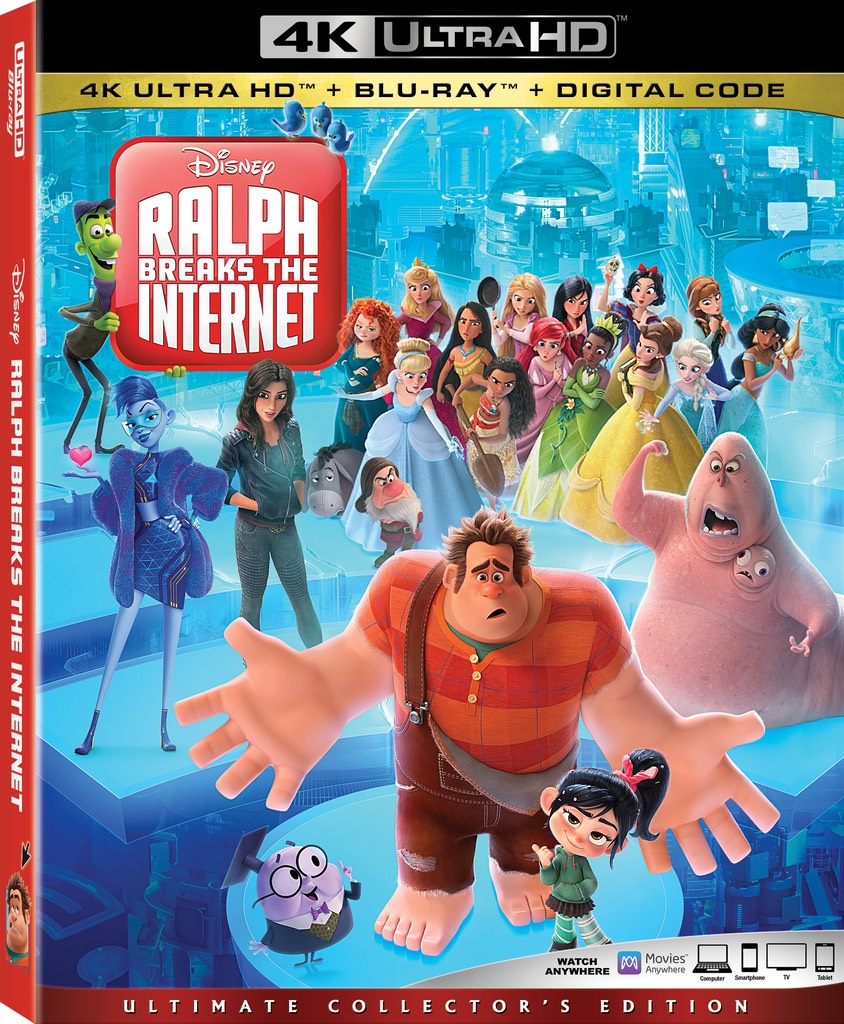
It was a marathon of magical experiences on Tuesday, Jan. 5 at Walt Disney Animation Studios when members of the media were invited to attend a whirlwind series of presentations from the talent behind “Ralph Breaks the Internet”! Erin invited me to cover the event for her, and I was thrilled to visit the studios and learn more about the making of the film, which will be released on Digital 4K Ultra HD and Movies Anywhere on Feb. 12 and Blu-ray on Feb. 26.
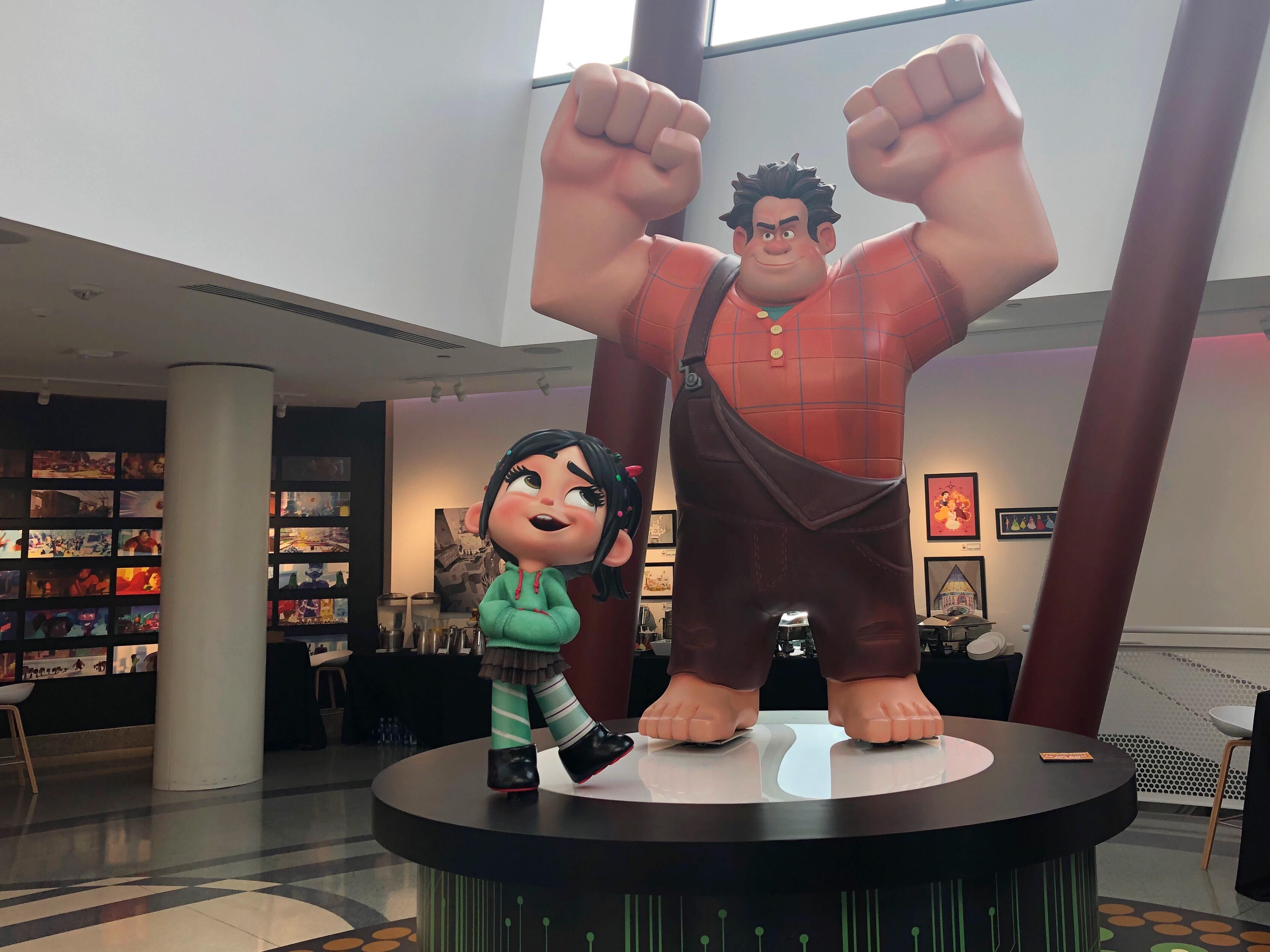
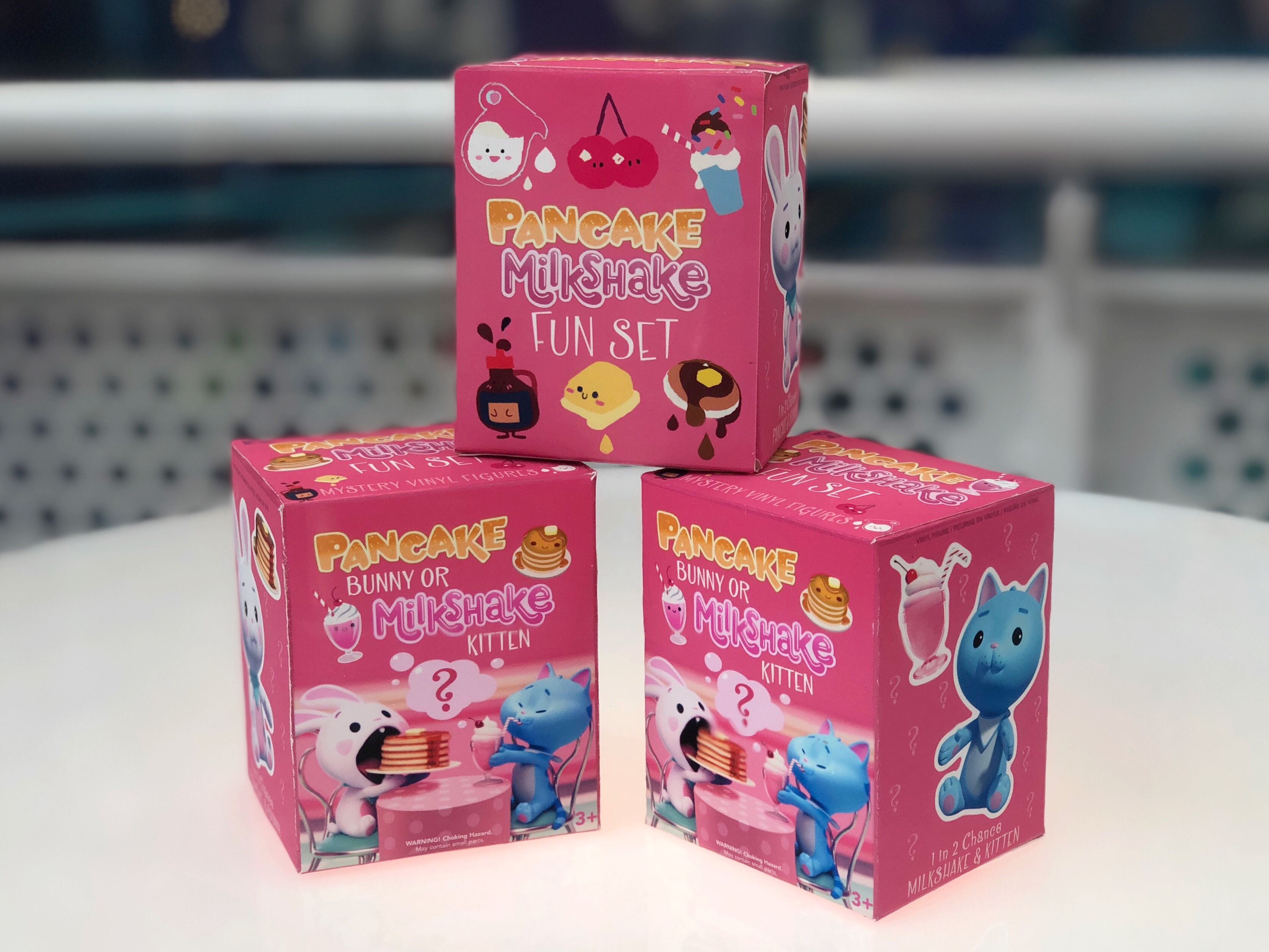
The day began with breakfast in the studio lobby, where we were surrounded by beautiful concept art from “Ralph Breaks the Internet.” A giant sculpture of the movie’s lead characters, Ralph and Vanellope, towered over us as we perused the artworks, which included character designs, expansive background scenes, and prop models used during film production, such as the “Sugar Rush” steering wheel and “Pancake Milkshake” mystery boxes.
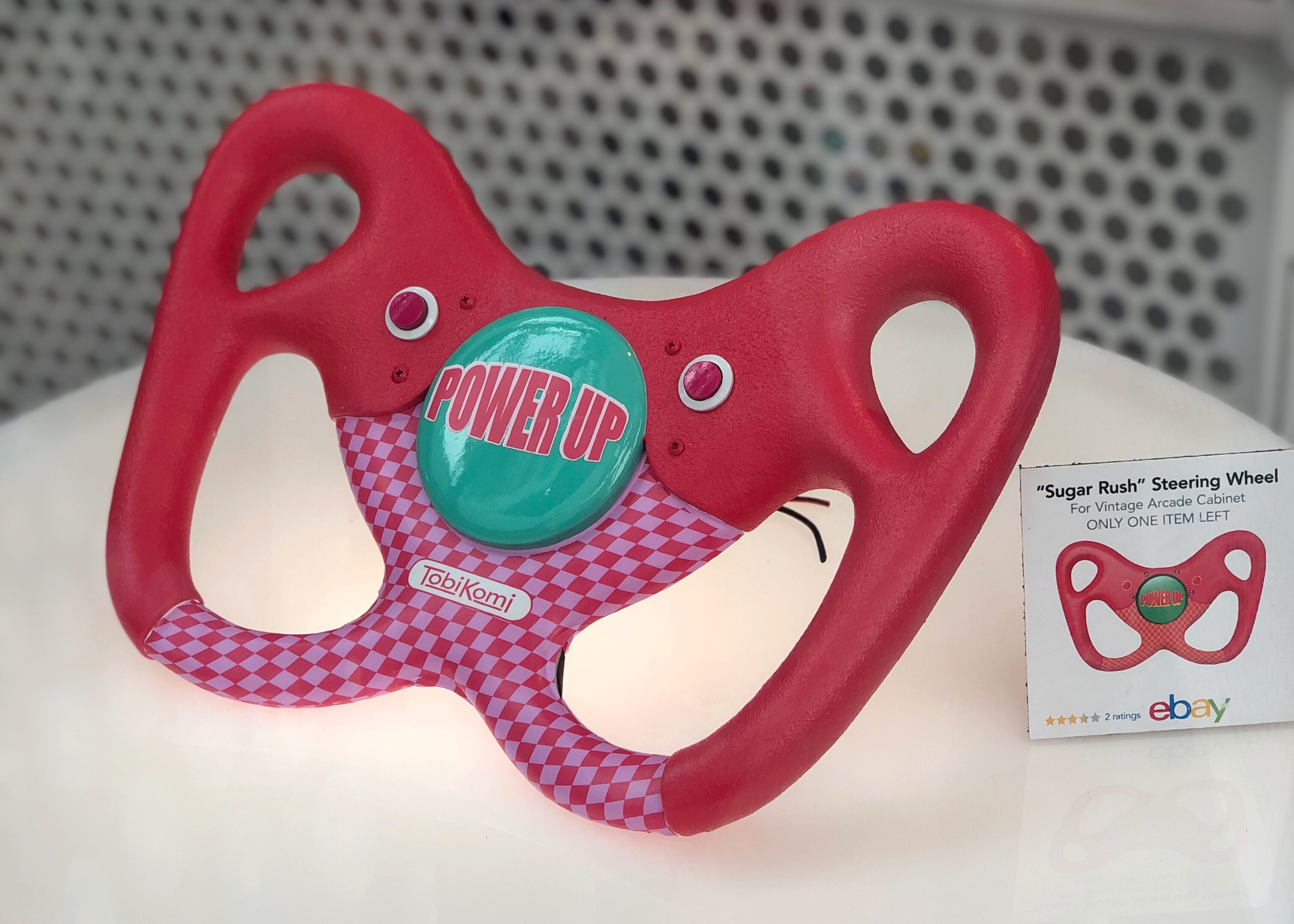
"Sugar Rush" Steering Wheel from Ralph Breaks the Internet

Pancake Bunny or Milkshake Kitten Fun Set

We were soon led into a screening room to watch a showcase of “Ralph Breaks the Internet” digital and DVD bonus features. Producer Clark Spencer introduced the two pieces: the first revealing a few of the many Easter eggs hidden in the movie, and the second about building the visual world of the Internet for Ralph and Vanellope’s journey.

Sharp-eyed viewers searching for Easter eggs can spot hidden Mickeys, references to past Disney animated features such as “Frozen,” “Big Hero 6,” “Zootopia,” and “Moana,” and the number A113 – the graphics and animation classroom at California Institute of the Arts, alma mater of many Disney animators. The movie’s directors even had favorite Easter eggs from the movie. Rich Moore loved seeing some of legendary animator Mark Henn’s hand-drawn characters strolling around the Oh My Disney section of the Internet, and Phil Johnston enjoyed a reference to “Zootopia” character Bellwether’s “World’s Greatest Dad Assistant Mayor” mug during Ralph’s viral video scene.

Spencer then introduced the next bonus feature segment, all about the film’s production process. “When we started talking about making a sequel to ‘Wreck-It Ralph,’ we really wanted to take the audience to a completely different place,” he said. “When the idea of the Internet came into being, we really felt like we had something there, something that made it worth doing a second story with these two incredible characters.” But how were the filmmakers going to go about turning the Internet into a believable, visual world with which Ralph and Vanellope could actually interact?
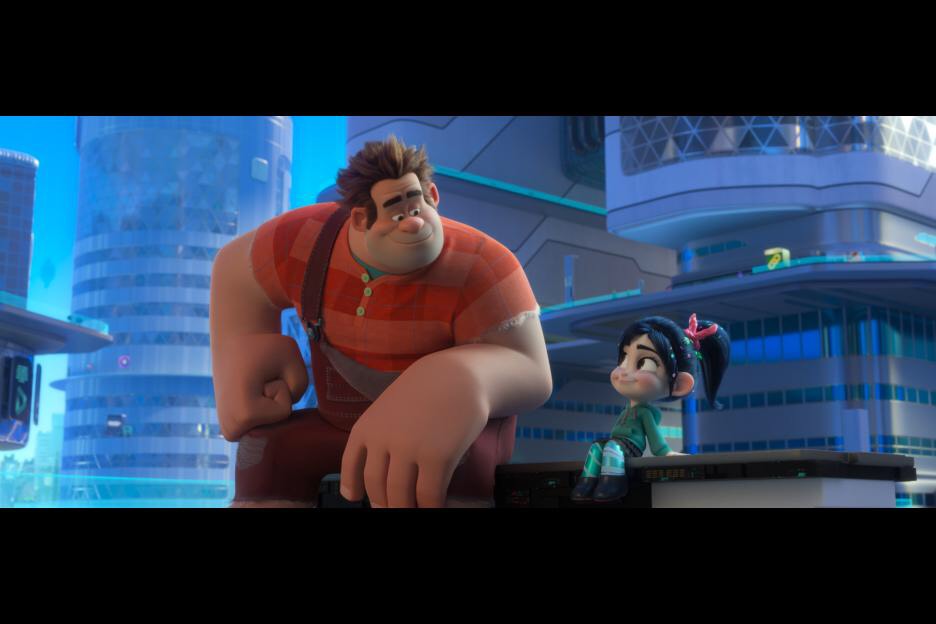
The segment features interviews with directors Moore and Johnston, animators, story artists, and more who share many of the inspirations, in-jokes, and production secrets behind the making of “Ralph Breaks the Internet.” In one segment, Moore and Johnston shared that they consulted with some of Disney’s technical talent and realized the world of the Internet was much more tactile than they had initially envisioned. The filmmakers’ research for the movie included a visit to One Wilshire, a data center in downtown Los Angeles that houses actual communications boxes and huge cables that provide a highway for massive amounts of Internet traffic. In their own quest for inspiration, animators broke apart actual computer pieces and studied the circuitry, which inspired the design for the bustling Internet metropolis visited by Ralph and Vanellope. They even consulted with stunt driver Jeremy Fry and drove cars at a racing facility to gain firsthand knowledge for creating the “Slaughter Race” sequences.
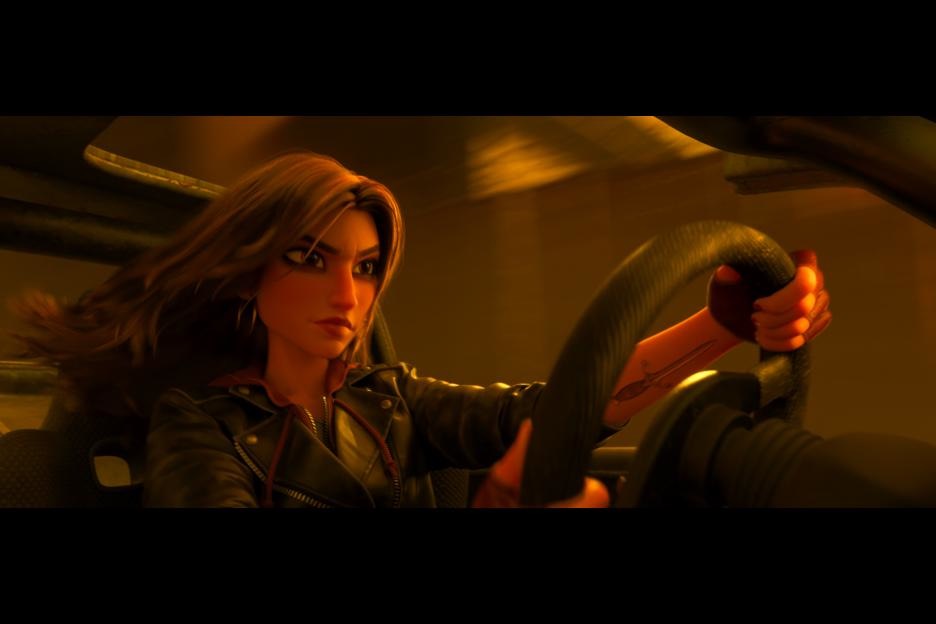
“Slaughter Race” sequence in Ralph Breaks the Internet

It was so much fun watching a preview of the features and gaining more insight into the complex world of the movie. (My favorite segment was about the creation of the iconic princess scene!) Moore and Johnston appeared in person at the end of the showcase for a Q&A and spoke fondly about the actors and artists they worked with during production and shared some of their favorite moments from the film.

Next on the agenda was a visit to a Disney computer training lab to enjoy a firsthand experience animating Vanellope! Co-Head of Animation Renato dos Anjos and Rigging Supervisor Nicklas Puetz began by explaining the meaning of “rigging,” which is creating a digital, three-dimensional rendering of a character or object that can be animated. First, the art department provides final 2D designs for the characters to the modeling department, where artists then sculpt 3D models of the characters and pass them on to the rigging department, which creates a skeleton, musculature, layers of skin or fur, and clothing for the character. The fully rigged characters are then sent to the animation department to be brought to life for the movie.

Puetz circled the room coaching all of the honorary animators while dos Anjos explained how to use the computer program to pose Vanellope and give her a few simple movements to perform. I’ll confess that rigging/animation requires great skill and precision, and many of our final animations looked pretty awkward, but they weren’t too bad for a half hour of training! When I was kid I wanted to be a Disney Animator when I grew up, so getting a hands-on rigging/animation lesson from Disney artists was a little dream come true.
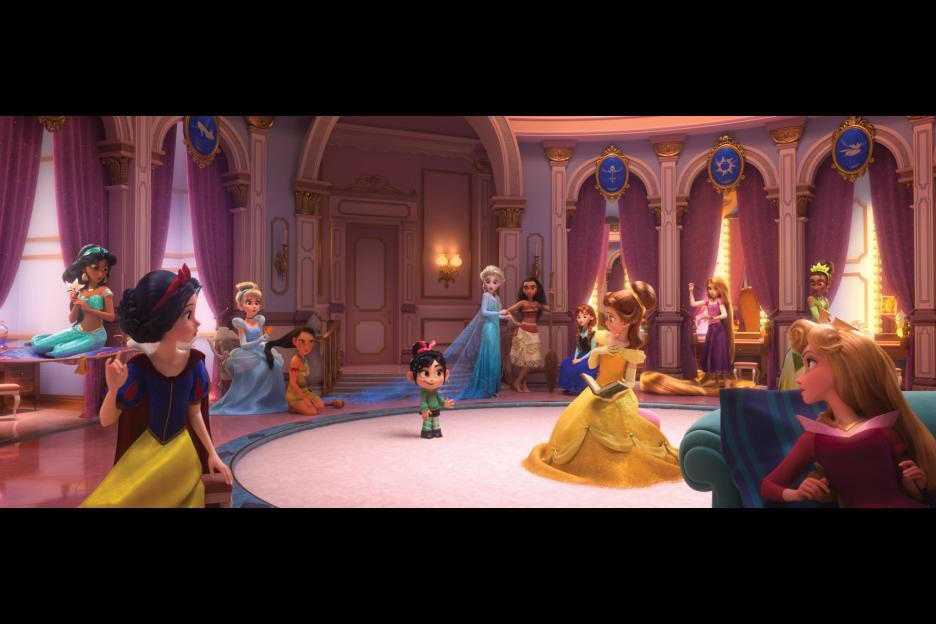
Disney Princess Scene

After rigging, it was time to learn more about the creation of the film’s visual effects, including “Ralphzilla,” the studio’s most technically challenging character to date. We met with Associate Producer Brad Simonsen, Technical Supervisor Ernie Petti, and Visual Effects Supervisor Scott Kersavage, who shared the challenges and triumphs of working on the expansive universe of “Ralph Breaks the Internet.”

The visual effects department had to bring three worlds to life: the game environments of “Wreck-It Ralph,” the “real” world of Litwak’s Arcade, and the Internet. But within those worlds were many smaller settings, as Ralph and Vanellope visit individual games and websites throughout the film. Not only were there 150 master sets to create and manage, but the complexity of the Internet world meant that some scenes had around 100,000 individual animated elements. To put it in perspective, “Wreck It Ralph” had 223 characters and 421 variants of those characters, while “Ralph Breaks the Internet” had 434 characters with 6,752 variants!

About a year into production, Simonsen, Petti and Kersavage received script pages containing the first mentions of “Ralphzilla,” a gargantuan, monster-like embodiment of Ralph’s insecurities made up of millions of Ralph clones. Though the prospect of creating such a complex character was exciting for the visual effects team, it also posed unprecedented technical challenges. The filmmakers studied beekeepers and the movements of groups of ants to animate the crawling Ralph clones that make up Ralphzilla’s body structure. The final Ralphzilla stood the real life equivalent of 783 feet tall, with the number of clones topping out at 5,443,098 – more than the entire population of Los Angeles! The studio broke new technical ground with “Ralph Breaks the Internet,” and the dazzling results are a testament to their efforts.
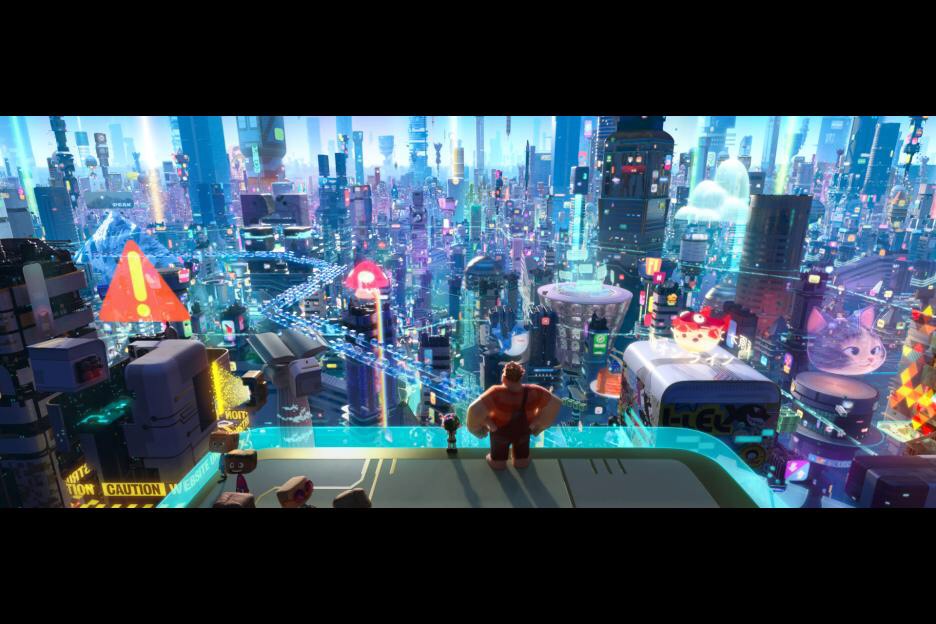
Cityscape Scene from Ralph Breaks the Internet

But where would all of that beautiful animation be without the vocal talent that brings the characters to life? For our final session of the day we had the opportunity to sit down with Emmy-nominated actor Alan Tudyk, voice of Knowsmore in “Ralph Breaks the Internet,” to discuss his work in the film and his relationship with Disney. In addition to live action movies, T.V. shows, and theatre, Tudyk has done voice work throughout his career. His relationship with Walt Disney Animation began with “Wreck-It Ralph,” in which he played King Candy, a charmingly eccentric arcade game figurehead hiding a villainous past. (He won an Annie Award for Voice Acting in a Feature Production for his portrayal of the character.) He worked with Jennifer Lee on “Wreck-It Ralph,” who went on to direct “Frozen” and cast Tudyk as the Duke of Weaselton. Tudyk has since voiced characters in Disney movies and T.V. series such as “Rogue One: A Star Wars Story,” “Big Hero 6: The Series,” and “Star vs. the Forces of Evil,” as well as being cast in every subsequent Disney animated feature film. He has even informally become known as Walt Disney Animation’s “good luck charm.”

But King Candy met his demise at the end of “Wreck-It Ralph,” so how were the filmmakers going to feature Tudyk in the sequel? When the character of Knowsmore, a smarty-pants search engine, was written into the script, the filmmakers knew the talented Tudyk was the one to bring the character to life. Knowsmore’s design was based in part on Professor Owl, a bespectacled blue owl featured in multiple Disney animated shorts, and his particular voice was a new one for Tudyk, which was found through experimentation in the recording booth using Truman Capote, Droopy Dog, and a bit of Jerry Lewis as vocal inspirations. He was also given the freedom to improvise, especially with Knowsmore’s hilariously rapid-fire search results.
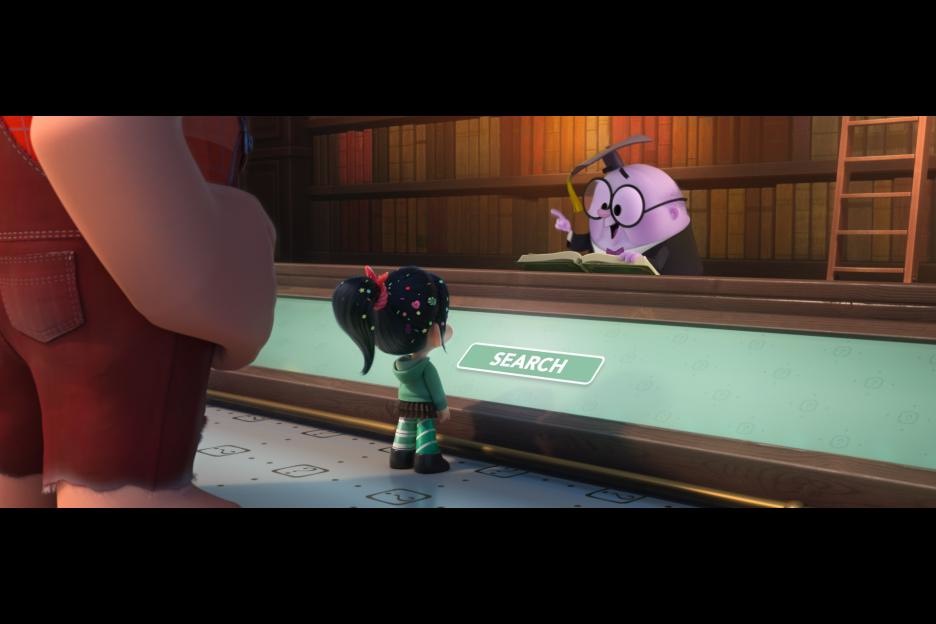
“The way that Disney makes movies, they grow as it goes along,” said Tudyk. “Certain things get cut and new characters come about, so you’re on a journey with it as well. It’s almost like doing a T.V. show in the sense that your character is always growing, there’s always new stories, you’re learning new things about your character. It’s constantly challenging, but fun.” Interviewing Tudyk is fun, too, as he would often slip into the voices of his characters and had us cracking up with anecdotes about his career and his time in Disney’s recording booths.

There’s a wealth of great content to be found on the bonus features of the in-home release of Disney’s “Ralph Breaks the Internet,” so be sure to check it out for yourself! The film will be packaged and released in multiple formats, allowing families to watch the movie instantly and on a variety of devices. It will be available on Digital 4K Ultra HD, HD, SD, and the Movies Anywhere app on Feb. 12. Starting Feb. 26, Ralph fans can purchase the 4K Ultra HD Combo Pack (4K Ultra HD, Blu-ray, and Digital Copy), a Multi-Screen Edition (Blu-ray, DVD, and Digital Copy), or a single DVD.

Huge thanks to Walt Disney Animation for hosting this awesome event, and to Erin for inviting me to cover for her!

“Mary Poppins Returns” is a Dazzling Sequel That Aims to Delight Fans of the Original

“Mary Poppins Returns” a Dazzling Sequel 

By Melanie Gable

*Hi, everyone! I’m so excited that Erin invited me to guest write this review for her blog! I attended a press screening for “Mary Poppins Returns” for the purposes of this post. All thoughts and opinions are my own.*

When Walt Disney Studios first announced that they would be making a sequel to their beloved, Oscar-winning 1964 film “Mary Poppins,” Disney fans’ reactions on social media were decidedly mixed. A movie musical that combined live action film with animation, the original “Mary Poppins” has stood the test of time and captivated multiple generations. Some of the film’s enthusiasts were elated by the prospect of revisiting Cherry Tree Lane (the setting of the first movie) and seeing a new Poppins story, while purists thought the property should be left alone.

But fans needn’t have worried, because “Mary Poppins Returns” simultaneously pays homage to the original film and does its own dazzling thing, exploring new territory in the Poppins-verse, with nostalgic nods to “Mary Poppins” peppered throughout the sequel. Deftly directed by Rob Marshall (“Into the Woods,” “Chicago”), who certainly knows his way around a musical, “Mary Poppins Returns” is a lively, enchanting, and loving tribute to P.L. Travers’ Poppins books and a (practically) perfect companion piece to the first film. If you missed what the cast had to share about the film the other day, make sure to check that out too!

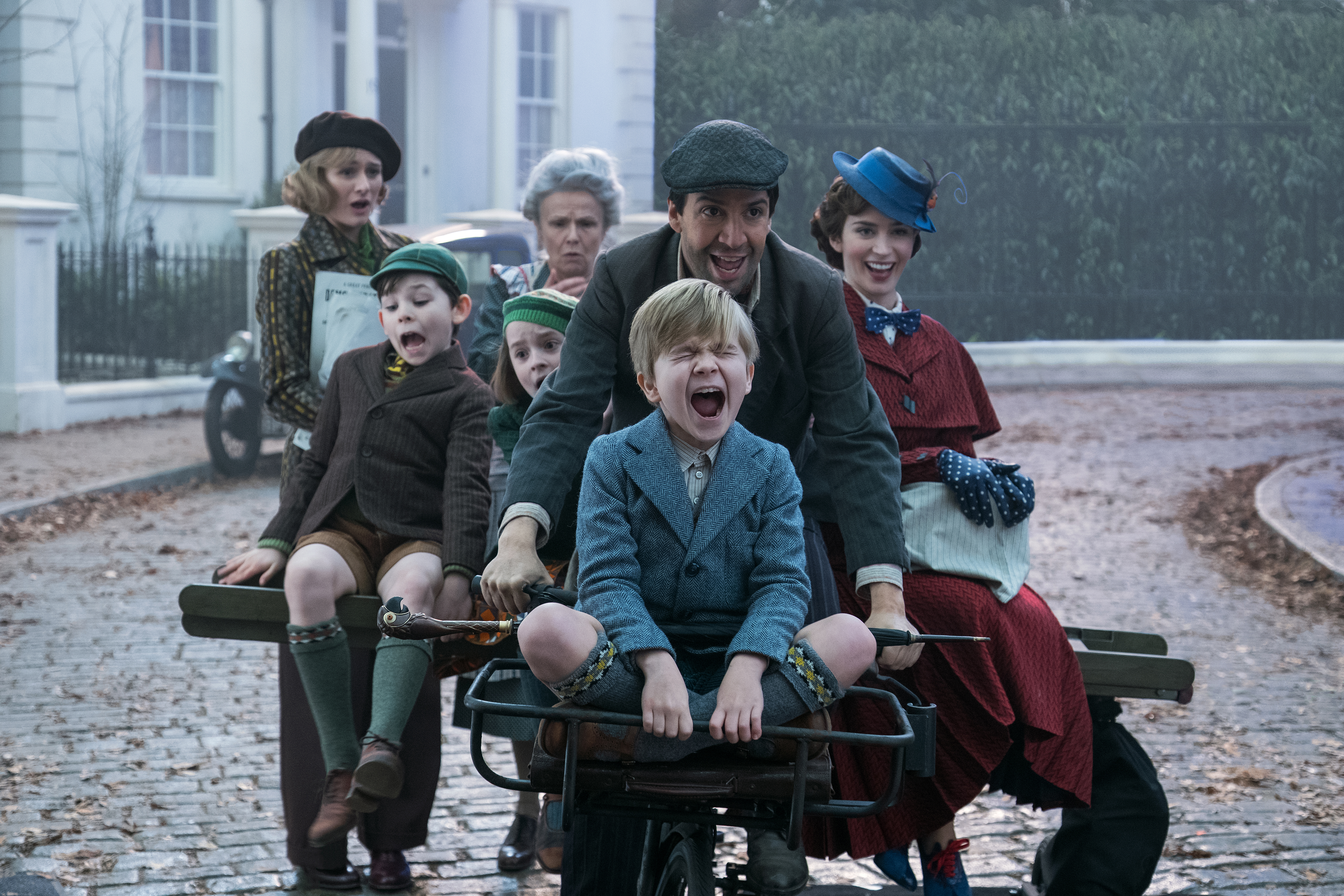
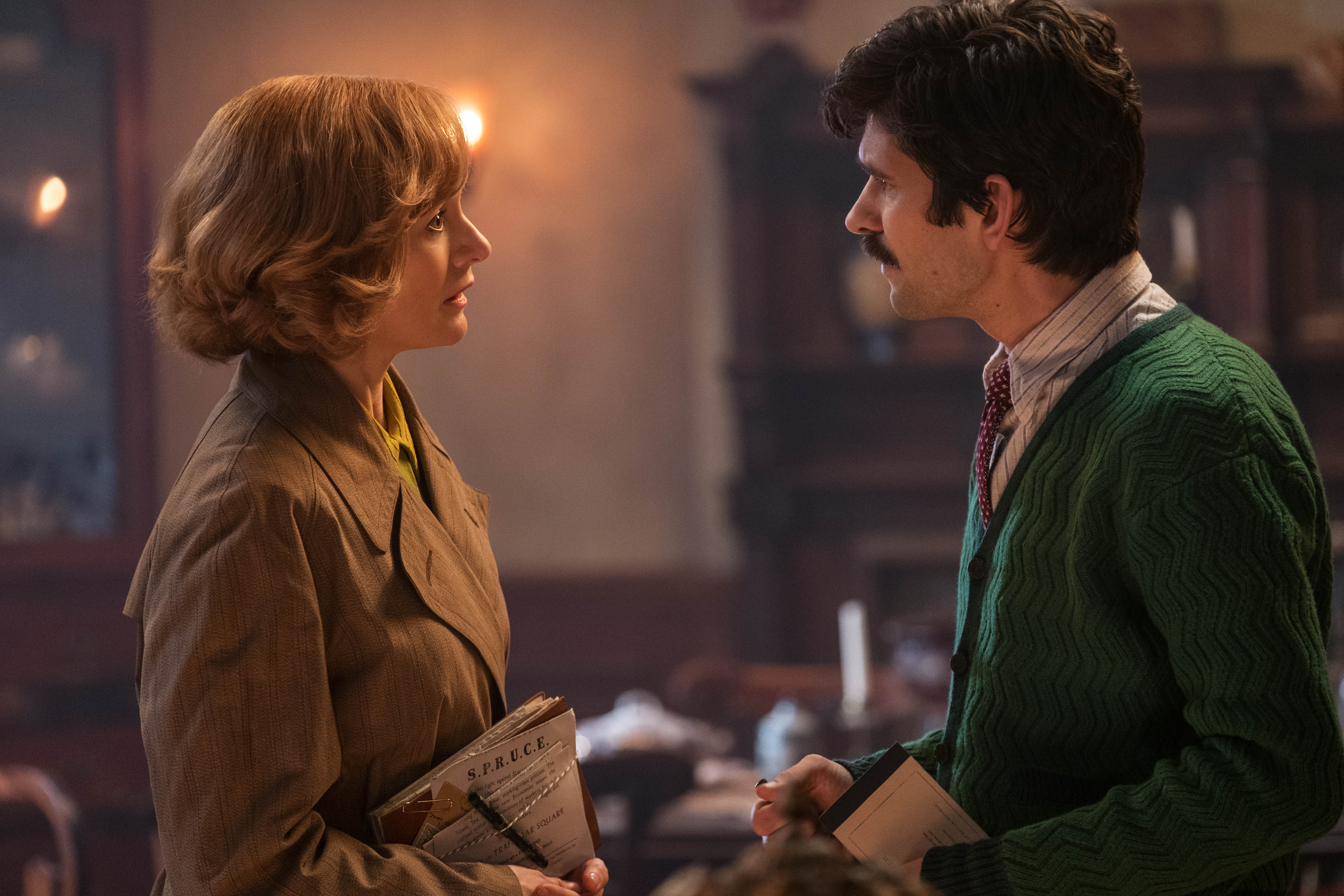
The movie takes place in Depression-era London, two decades after the events in “Mary Poppins.” Jane and Michael Banks, the sibling charges of the magical nanny in the original movie, are all grown up, with grown-up problems. Michael (Ben Whishaw), now a struggling artist and father of three children, is dealing with the recent passing of his wife and the subsequent chaos his house is thrown into as he attempts to keep up with the financial and emotional responsibilities of single fatherhood. Jane (Emily Mortimer), a busy, independent woman campaigning for workers’ rights, still has the warmth and sweetness of her childhood self, checking in on and helping her brother whenever she can. Michael’s loyal housekeeper and cook, Ellen (Julie Walters), is getting on in years and, though well-intentioned, is prone to being scatterbrained and clumsy. The Banks children – Annabel (Pixie Davies), John (Nathanael Saleh), and Georgie (Joel Dawson) – assume additional responsibilities to help with the household as various tasks, such as grocery shopping, fall through the cracks. We are also introduced to Jack (Lin-Manuel Miranda), a charming, optimistic lamplighter and acquaintance of Bert, Dick Van Dyke’s chimney sweep character in “Mary Poppins,” who is soon drawn into the Banks’ family drama.

Fidelity Fiduciary Bank, the place of Michael’s employment, soon comes calling with bad news: due to late payments, Michael must now pay back his entire mortgage on 17 Cherry Tree Lane by the end of the week, or he will lose the property. Though the sum is more than Michael makes in a year and all seems lost, there is one ray of hope – the shares his father, a partner at Fidelity Fiduciary, owned in the bank. As Jane and Michael search the home for the shares certificate, they come across various mementos from their childhood, including the lovingly patched kite featured in the song “Let’s Go Fly a Kite” at the end of “Mary Poppins.” In a moment of frustration and grief, Michael takes a box of his childhood relics to the curb, including the kite, to be picked up for disposal. The kite almost immediately catches a gust of wind, skittering along the street and eventually taking to the sky.

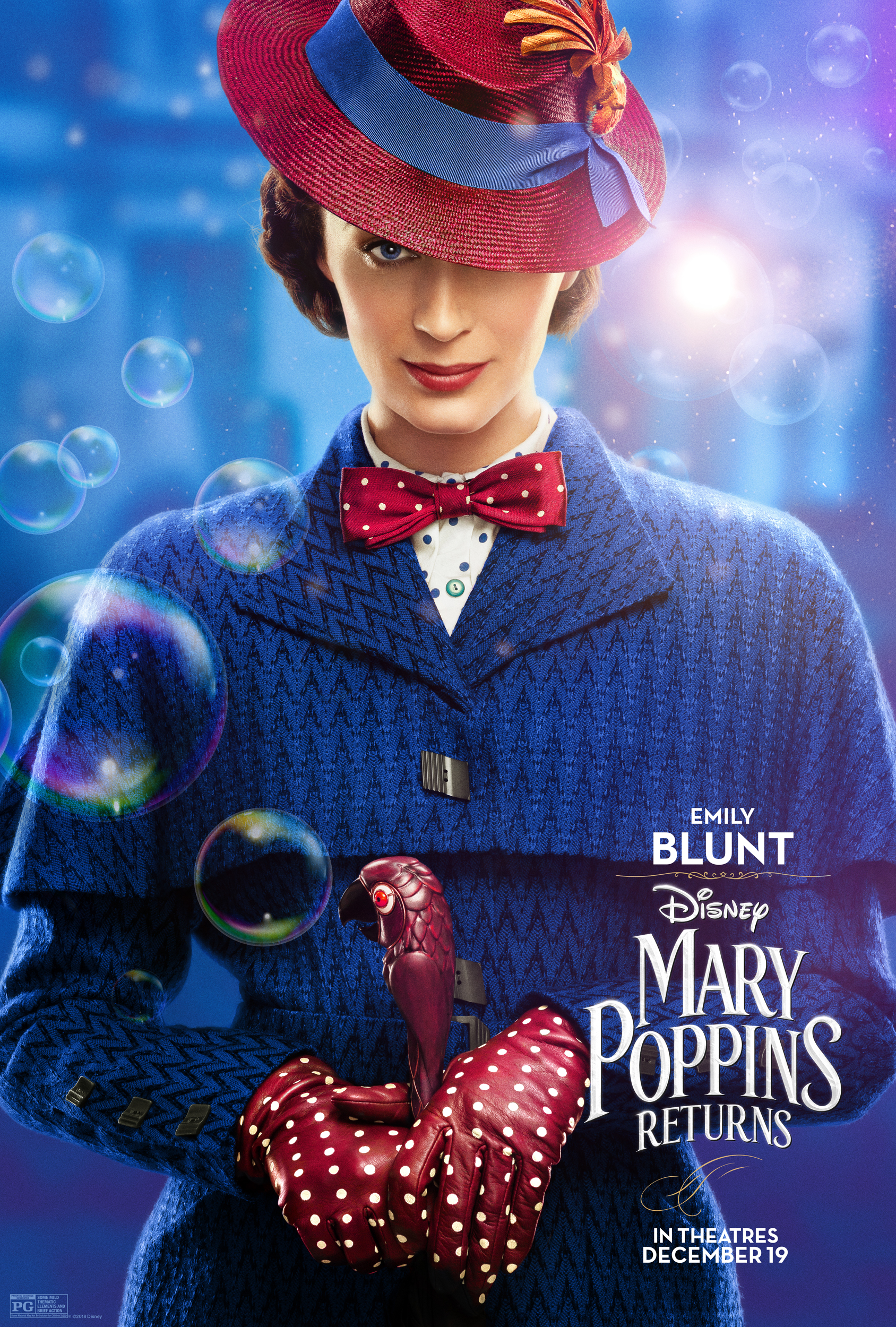
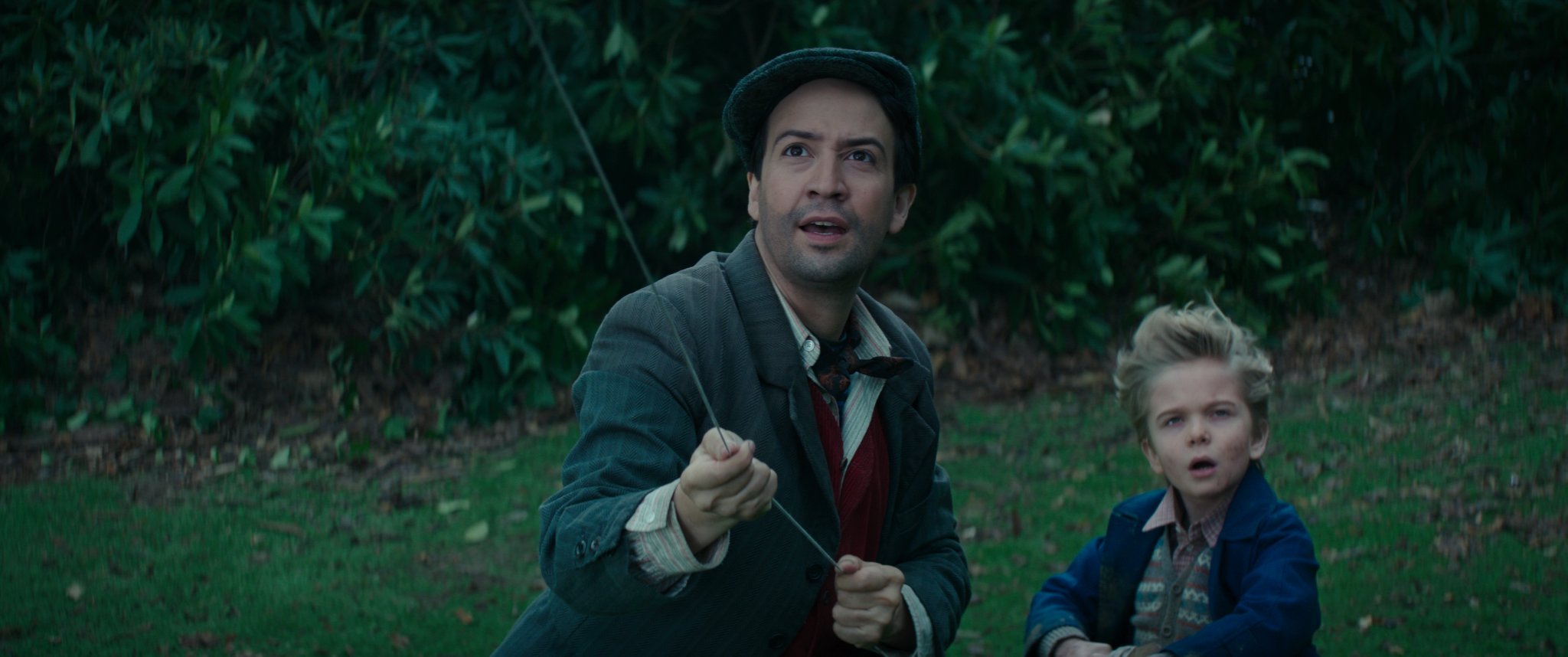
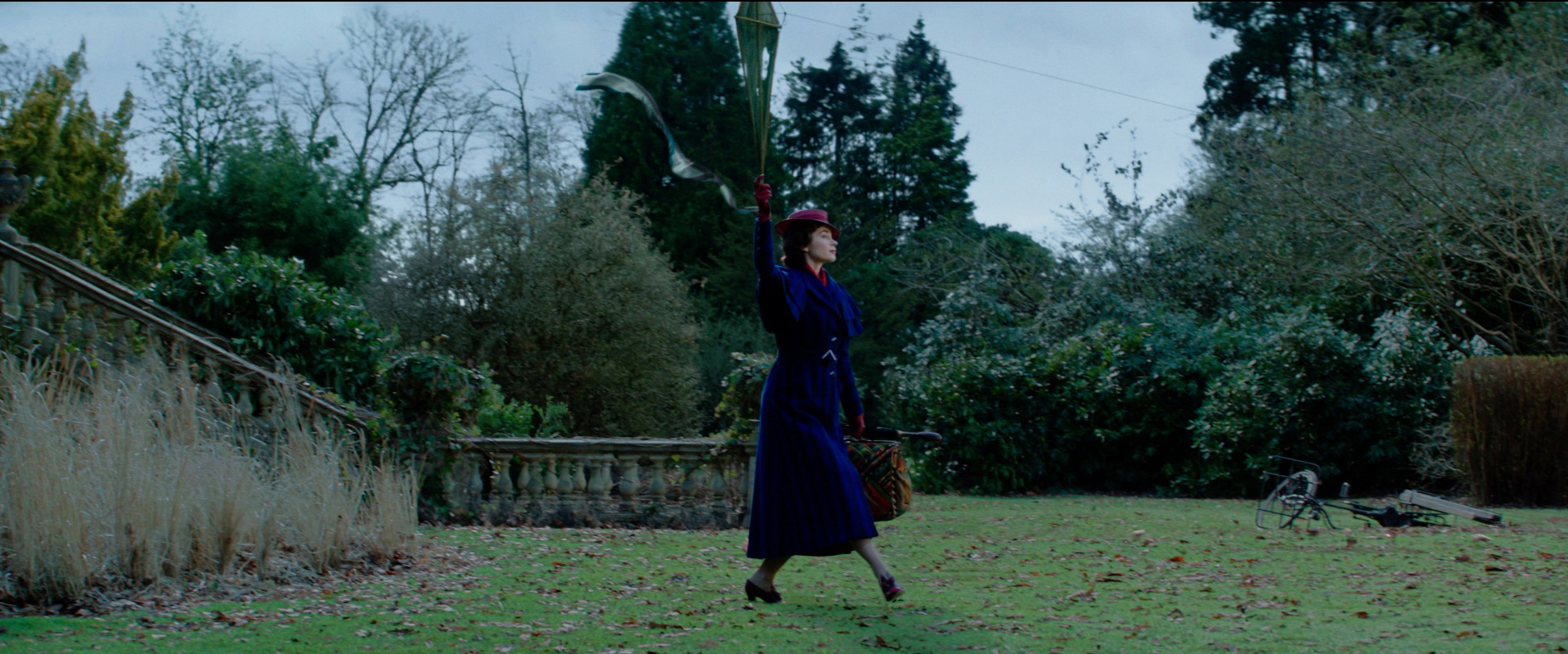
 As the Banks children cut through the local park on their way to the market, Georgie spots the old kite flying wildly in the wind and begins to chase it. As the kite ascends higher and higher into the cloudy sky, Georgie finally catches hold of the string and crosses paths with Jack the lamplighter, who helps him reel it in. Into the fray floats Mary Poppins in her signature style, holding the kite in one hand and her parrot umbrella in the other, chin held high, toes pointed outward, and an air of mystery and magic about her. Jane and Michael are shocked when Mary Poppins arrives unceremoniously at 17 Cherry Tree Lane with Michael’s children in tow. She’s clearly the same nanny they remember, and shows no visible signs of aging since they were children. At Jane’s insistence (because Poppins might be down on her luck and need the work), Michael reluctantly hires Mary Poppins to care for his children. As is her way, Mary Poppins begins infusing fun and whimsy back into the Banks’ children’s lives, while steering the family toward the solutions to their problems behind the scenes.

Continue reading »

The Cast & Crew of “Mary Poppins Returns” Share the Stories Behind the Magic

The Cast & Crew of “Mary Poppins Returns”

By Melanie Gable

*Hi, everyone! I’m so excited that Erin invited me to guest write for her blog! I attended the press junket for “Mary Poppins Returns” for the purposes of this post. All thoughts and opinions are my own.*

The Montage Beverly Hills was decked out in sparkling holiday decor on November 28, but the hotel became even more magical when the cast and crew of Walt Disney Studios’ “Mary Poppins Returns” held a press conference to talk about the process of making the enchanting new film.

Directed by Rob Marshall (“Into the Woods,” “Chicago”), this all-new, original musical is a sequel of sorts to Disney’s Oscar-winning “Mary Poppins,” which was released in 1964 and starred Julie Andrews in the titular role. “Mary Poppins Returns” revisits the charming setting of the first film, Cherry Tree Lane, but it is now the 1930s, and Jane and Michael Banks are adults navigating their way through “The Great Slump,” a time of economic downturn in England. Emily Blunt steps gracefully into the Poppins role, with Broadway superstar Lin-Manuel Miranda as Jack the Lamplighter, and Ben Whishaw and Emily Mortimer as grown-up siblings Michael and Jane Banks.

In the ballroom waiting area of the Montage, members of the press, bloggers, and special guests were treated to animated photo ops and a close look at some of the gorgeous costumes from the film, including several that were hand-painted by costume designer Sandy Powell. In the ballroom itself, a lovely scene was set for the film’s luminaries, with faux cherry trees adorning the stage and a bright blue backdrop featuring the movie’s title.

Producer Marc Platt served as the moderator for the conference and introduced the cast and crew in attendance:

  • Emily Blunt (“Mary Poppins”)
  • Lin-Manuel Miranda (“Jack”)
  • Ben Whishaw (“Michael Banks”)
  • Emily Mortimer (“Jane Banks”)
  • Director Rob Marshall
  • Producer John DeLuca
  • Composer Marc Shaiman
  • Lyricist Scott Wittman
  • Screenwriter David Magee

Platt began by asking Marshall why he chose to direct “Mary Poppins Returns.” Throughout the conference the cast and crew expressed how influential the original “Mary Poppins” had been on their respective childhoods, and Marshall was no different. “I really felt like I have that film, as many of us on this panel do, in our blood. And I wanted to be able to, in an odd way, protect the first film and treat this film with great care and love,” said Marshall. He also shared that it was “a dream” to be at helm of an all-new musical, and create it from scratch.

As for the role of Mary Poppins, Marshall gushed that there was “not another person on this planet who could have played that part” than Emily Blunt. Marshall directed Blunt in Disney’s film version of “Into the Woods,” so they have a history of collaborating on musical projects. When it came time to cast the movie, Marshall called Blunt and told her they’d been digging through the Disney archives and were returning to the company’s “most prized possession.” After keeping Blunt guessing for a bit, Marshall revealed that it was “Mary Poppins” and Blunt said, “the air changed in the room.” It was an extraordinary moment for her, and she said she instantly wanted to play the role. But her acceptance was with trepidation, because Mary Poppins is so iconic and has had such a profound impact on her life and the lives of so many others. “People hold this character so close to their hearts,” Blunt began, “And so, you know, how do I create my version of her? What will my version of her be because…no one wants to see me do a sort of cheap impersonation of Julie Andrews, because no one is Julie Andrews. And so she should be preserved and treasured in her own way of what she did.”

Blunt found inspiration for her own portrayal of Mary Poppins by turning to P.L. Travers’ books, which were “a huge springboard and enormously helpful” to her. Blunt loved the duality of the character – Poppins’ laughably quirky and off-putting characteristics, like vanity, sharpness, and occasional downright rudeness, paired with her deep empathy, altruism, and kindness. “She has to herself have such a childlike wonder in her in order to want to infuse these children’s lives with it, and there must under there be a generosity of spirit to want to fix and heal in the way that she does,” Blunt observed about the character. Marshall and Blunt talked frequently about Mary Poppins in the year and a half before they started rehearsing the movie, and they both shared the desire to capture the many nuances and layers of the character. Plus, Blunt joked, Poppins is “probably a bit of an adrenaline junkie…she loves these adventures.” Blunt described the role as “delicious,” and relished the opportunity to play such an enigmatic character.

Lin-Manuel Miranda, who plays Jack the Lamplighter in the movie, is best known as the writer and star of the smash-hit Broadway musical “Hamilton.” Truly a triple threat (or, more accurately, a quintuple threat?), Miranda is a playwright, composer, lyricist, singer/rapper, and actor with a slew of accolades under his belt, including Emmy Awards, Grammy Awards, Tony Awards, and even a Pulitzer Prize. Miranda also co-wrote the beautiful songs in Walt Disney Animation Studios’ “Moana,” and even showcased his vocal skills on the film’s soundtrack. Though Miranda has appeared in multiple T.V. shows and movies, “Mary Poppins Returns” marks his first starring film role.

Continue reading »